|
Description
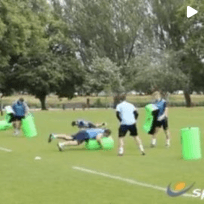
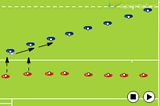
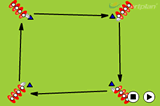
- Using cones mark out a 10 meter x 10 meter grid. Have more than one grid to keep as many of your players as busy as possible, and feel free to change the grid measurements to suit your own players and their/you training and session goals. There will be two balls in each grid.
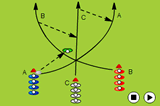
- Divide your players into groups of 4.
- Have 4 groups of 4 work at each training grid, allocate a group to each cone.
- Keep your player briefing, brief! You may consider having a demonstration group.
- Give two players opposite each other, one ball each.
- On your call they will come forward, towards each other, sidestepping to avoid contact before passing the ball either left or right.
- There should be no forward passes and the players need to communicate to avoid both balls going in the same direction.
- When the receivers collect their pass - they do the same as the first set of ball carriers.
- Players that have completed their run and pass within the grid should join the end of the opposite line.
- Players should seek opportunity to pass off both their left and right hands.
Coaching Points
Don't feel that you have to focus on all of the following coaching points, you may have your own. Select the points that most closely match your overall training and session goals. - Players work within the training area at a high tempo.
- Receivers hands are our ready to take the pass.
- Ball carriers attack at pace.
- Ball carriers avoid contact by using changes in foot-speed, they stay on the balls of their feet, they sidestep, and communicate.
- Communication must be effective (loud enough), efficient (brief but with enough information to get the job done), and encouraging (highlighting good work, effort, and that the next pass etc. is the most important).
- Receivers call the ball, ball carriers verbally look for support.
- Passes are not forward.
- Passes are weight correctly in terms of speed, distance, and accuracy.
- Passes are not spun unnecessarily.
- A pass is only good when caught.
- Players are creative e.g. spinning to avoid contact, use non traditional passing e.g. a flick.
- Players communicate in advance to decide on the direction of the pass.
- Mistakes happen, you as a coach focus on the fix and let the players play.
- Be upbeat and encouraging - provide opportunities for success and set realistic targets.
© Copyright Sportplan Ltd, 2013
|